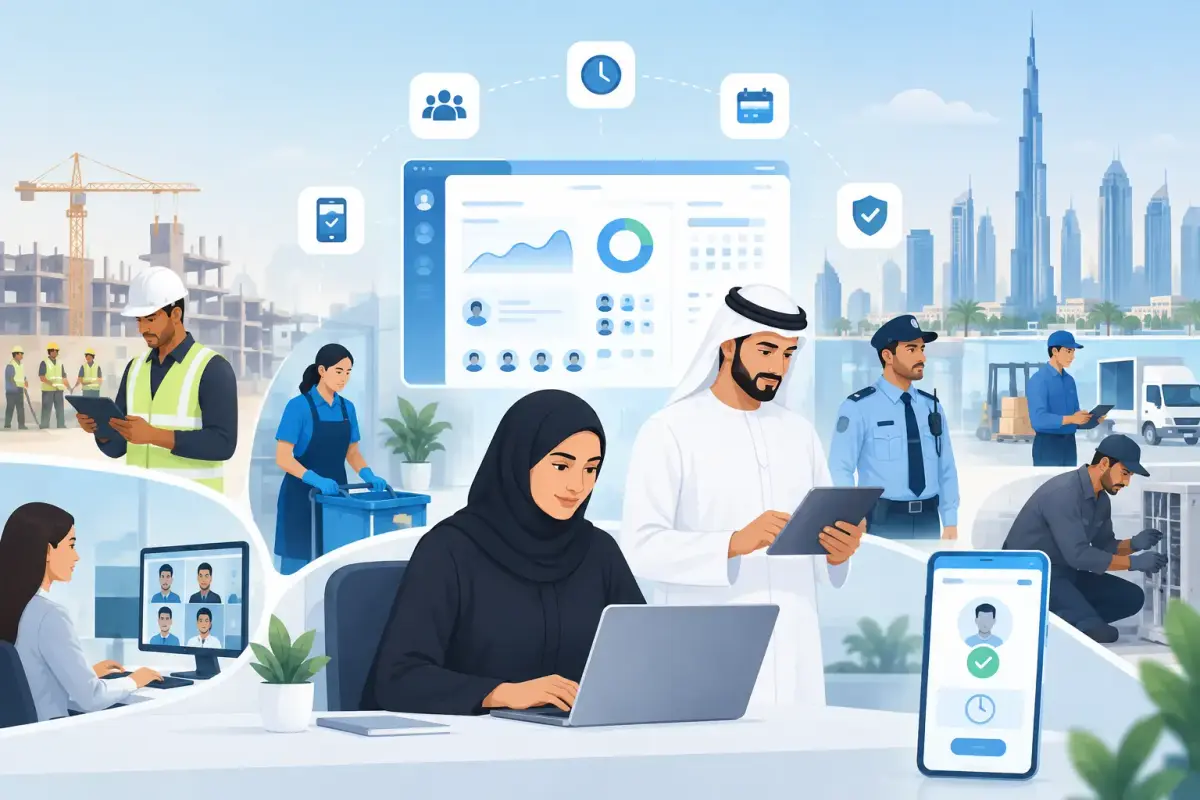
A missed clock-in at one site can become a payroll correction, a manager dispute, and a week of unnecessary follow-up. That is why digital workforce trends matter to growing businesses: they are not simply about adding new software. They are about making daily workforce decisions faster, more accurate, and easier to verify across offices, sites, shifts, and teams.
For companies in the UAE and GCC, the biggest change is clear. HR, finance, and operations teams are moving away from separate spreadsheets, paper approvals, and disconnected attendance tools toward one shared view of the workforce. The goal is practical: reduce manual work while giving employees and managers the information they need to act.
Digital Workforce Trends Moving From Hype to Operations
The most useful trends are not the flashiest ones. They solve recurring issues such as unclear attendance records, delayed leave approvals, overtime calculations, missing documents, and payroll data that must be checked repeatedly before processing.
Workforce data is becoming one operational record
Employee data used to live in too many places. HR maintained personal records, operations tracked shifts, managers handled leave requests in messages, and finance rebuilt payroll inputs every month. Each handoff created delay and increased the chance of conflicting information.
A centralized HRMS changes that model. Employee records, documents, attendance, leave balances, timesheets, claims, approvals, and payroll inputs can follow connected workflows rather than separate manual processes. When a leave request is approved or overtime is validated, the right teams can see the result without chasing updates.
Centralization does not mean every business needs a complex enterprise system. For an SME, it may simply mean replacing four spreadsheets with one platform that people actually use. For a security, logistics, cleaning, or construction business, it can mean connecting site attendance and shift records to payroll preparation. The right level of structure depends on workforce size, locations, and how variable the workday is.
Mobile attendance is replacing trust-based time records
For office teams, a standard clock-in process may be enough. For mobile and site-based teams, it rarely is. Supervisors need a reliable way to confirm who is present, where they clocked in, and whether staffing matches the planned shift.
Mobile clock-in and clock-out, geofencing, and face recognition are becoming more common because they give operations teams timely visibility. They can help reduce attendance disputes, identify missed punches early, and support accurate overtime tracking before payroll is finalized.
These controls need sensible setup. A geofence that is too small can create false exceptions around large worksites. Face recognition may be useful in high-volume environments but should be introduced with clear employee communication and practical fallback processes. Technology improves control when it reflects the reality of the workplace, not when it adds friction to it.
Flexible shifts and timesheets are now a core requirement
The fixed 9-to-5 schedule is not disappearing, but it is no longer the default for many workforce-heavy businesses. Rotating shifts, split shifts, variable hours, multiple sites, and project-based work require more than a basic attendance register.
Modern workforce management relies on configurable shift rules, assigned schedules, timesheet approvals, absence tracking, and overtime visibility. This helps managers compare planned coverage with actual attendance and address problems while they are still manageable. It also gives finance cleaner, approved inputs rather than a last-minute collection of emailed adjustments.
For growing companies, flexibility matters as much as automation. A workflow that works for 50 employees may need different approval paths at 300. The system should support change without forcing teams to rebuild their processes from scratch every time operations expand.
Payroll Is Becoming a Connected Workflow
Payroll is where weak workforce data becomes expensive. A missed shift update, an unapproved overtime entry, or an outdated salary adjustment can affect employee trust and create additional work for HR and finance.
One of the strongest digital workforce trends is connecting payroll preparation to approved HR and attendance records. Instead of re-entering data from several sources, payroll teams can work from centralized employee information, leave records, timesheets, claims, and approved adjustments. This helps reduce repetitive data entry and makes it easier to review exceptions before payroll is processed.
For UAE businesses, systems that support UAE WPS payroll requirements can make the monthly process more structured and easier to manage. This is not a substitute for internal review or professional guidance when needed. It is a way to keep the underlying employee and payroll data organized, traceable, and ready for the next step.
The operational benefit is significant. Finance spends less time asking where a number came from. HR spends less time correcting preventable inputs. Managers have clearer accountability for approvals that affect their teams.
Employee Self-Service Is Reducing Administrative Pressure
Employees increasingly expect to complete simple HR tasks without waiting for an administrator. They want to request leave, check balances, access documents, submit claims, update selected details, and view relevant information from a phone or desktop.
Employee self-service is often described as an experience feature, but its most immediate value is operational. Every request handled through a clear digital process removes an email, a paper form, or a message that someone must manually track. Managers can approve or reject requests with context, while HR retains a consistent record.
The same applies to manager self-service. A manager who can review attendance exceptions, approve timesheets, see pending requests, and monitor team leave schedules can resolve issues closer to where they happen. HR remains in control of policy and process, but does not need to become the bottleneck for every routine action.
Arabic and English access is especially valuable in diverse workforces. Adoption improves when employees can use a system in a language they understand and through an interface that does not require extensive training.
AI Is Useful When It Points Teams to Action
AI has become part of the workforce technology conversation, but the practical question is not whether a platform has AI. It is whether the insights help managers make better decisions.
For HR and operations teams, useful AI can highlight engagement signals, performance patterns, approval bottlenecks, or recurring attendance exceptions. It can help turn a large volume of workforce data into a short list of issues worth reviewing.
AI should support judgment, not replace it. A late clock-in pattern may reflect a schedule problem, a site-access delay, or an individual issue. Managers still need context before taking action. The best approach is to use insights as prompts for better conversations and process improvements, rather than treating automated outputs as final decisions.
What Businesses Should Prioritize First
Trying to digitize every workforce process at once can slow progress. Start with the areas that generate the most recurring manual work or business risk. For many organizations, that means attendance, leave approvals, timesheets, and payroll inputs.
Before choosing or configuring a system, map the real process. Identify who creates a record, who reviews it, who approves it, and where the data is used next. This often reveals that the problem is not only the spreadsheet. It is also unclear ownership, inconsistent approval rules, or too many exceptions handled outside the process.
Then focus on adoption. A simple platform with clear workflows delivers more value than an advanced system that employees avoid. Managers need fast approvals, employees need easy self-service, and payroll teams need reliable data. If any group finds the process difficult, manual work will return quickly.
Mowazaf is built around this practical approach, bringing HRMS, attendance, shifts, leave, payroll, workflows, and employee self-service into one localized platform for office and field workforces. The objective is not to add complexity. It is to give every team a more dependable daily process.
The companies that benefit most from workforce digitization are not those chasing every new feature. They are the ones that choose a few high-impact processes, make them simple to follow, and use the resulting data to run each workday with greater confidence.