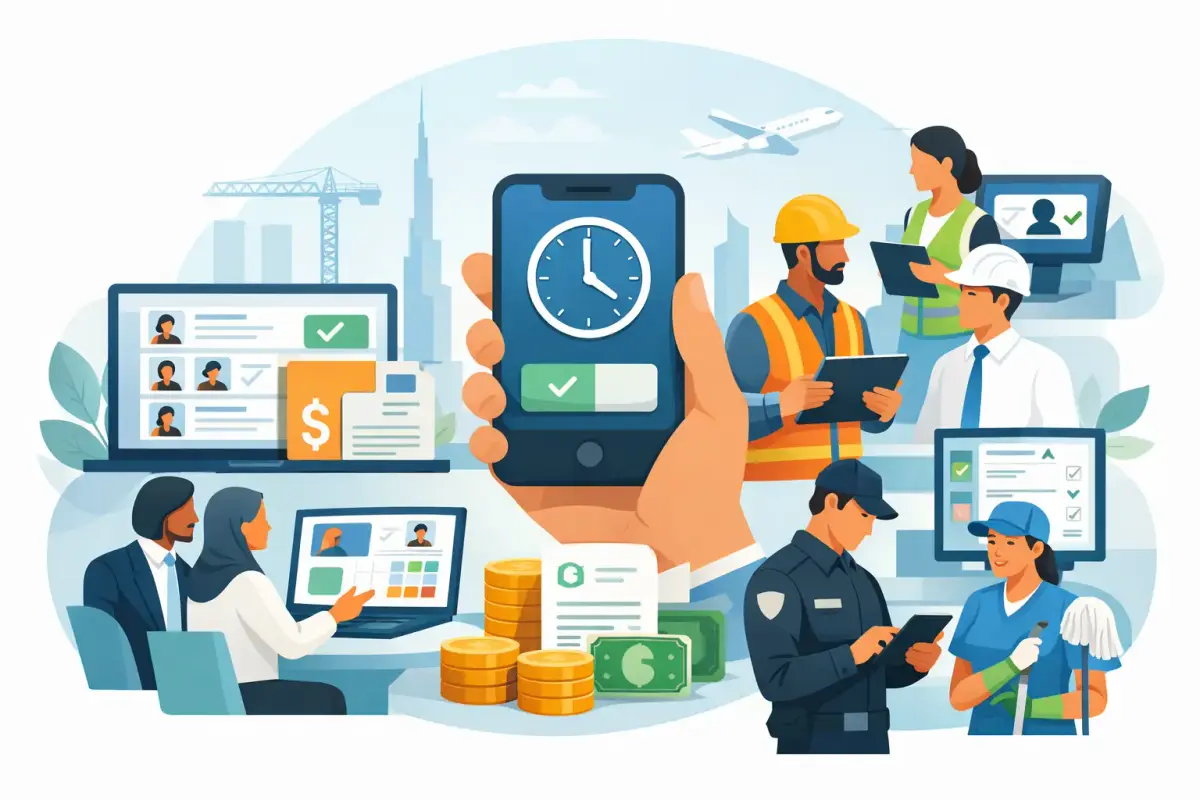
A payroll discrepancy rarely starts on payday. It often begins days earlier with an unapproved timesheet, a missed mobile clock-out, a shift change recorded in a chat, or an allowance adjustment buried in a spreadsheet. That is why GCC payroll trends are moving beyond faster salary calculations. Growing businesses are connecting payroll to the daily workforce data that determines what employees should be paid.
For HR, finance, and operations teams, the change is practical. Payroll is becoming a continuous process rather than a month-end rush. The companies seeing the strongest results are not simply adding another payroll tool. They are reducing the gaps between attendance, leave, overtime, claims, approvals, and final salary processing.
GCC Payroll Trends Are Becoming Operational Trends
Payroll used to sit mainly with finance. Now, it depends on reliable inputs from managers, site supervisors, employees, HR, and operations. This is especially clear in businesses with multiple locations, rotating shifts, field staff, or a large hourly workforce.
When payroll data is collected manually, each handoff creates risk. A supervisor may submit attendance late. HR may need to check leave balances separately. Finance may receive a revised overtime file after payroll has already been prepared. The issue is not only the time spent correcting records. It is the lack of a trusted source of truth.
The most meaningful shift across the GCC is toward connected workforce operations. Businesses increasingly expect the same system to capture attendance, apply approved leave, track overtime, route adjustments for approval, and prepare payroll-ready data. That does not remove the need for review. It gives reviewers cleaner, more current information before they make decisions.
For office-based teams, this may mean employee self-service for leave requests, payslip access, and document updates. For construction, security, cleaning, logistics, maintenance, and staffing businesses, it can mean mobile clock-in and clock-out, geofencing, shift assignment, timesheets, and site-level visibility. The underlying need is the same: payroll should reflect actual work without relying on scattered records.
Attendance Accuracy Is Now a Payroll Priority
Attendance is no longer treated as a separate HR task. It is one of payroll's most important data sources.
A fixed monthly salary may look simple, but exceptions quickly add complexity. Late arrivals, unpaid leave, overtime, night shifts, holiday work, missing punches, and shift swaps can all affect payroll. When teams reconcile these items at the end of the month, they work under pressure and employees have less time to raise valid questions before payments are processed.
This is driving greater use of mobile attendance, location-based controls, face recognition, and digital timesheets. These tools are not a replacement for sensible management. A geofence, for example, may be useful for a fixed worksite but less suitable for employees who travel between customer locations. Face recognition can reduce buddy punching, but companies still need clear processes for exceptions and connectivity issues.
The goal is not surveillance. It is dependable evidence of work time, supported by manager review. A good attendance setup gives supervisors a simple way to address missed punches and approve corrections while the information is still fresh. That helps reduce disputes later, when the data is harder to verify.
Approval Workflows Are Replacing Payroll Chasing
Many payroll delays come from waiting, not calculating. HR waits for managers to approve leave. Finance waits for HR to confirm salary changes. Operations waits for supervisors to validate overtime. Employees wait for someone to respond to a claim or attendance correction.
Digital approval workflows are becoming more important because they create ownership. Requests move to the right manager, follow a defined approval path, and leave an audit trail. The best workflows are flexible enough to reflect how a business actually operates, including different approval levels for departments, sites, or value thresholds.
There is a trade-off. Overly complex workflows can slow the business down just as much as email. A company does not need five approval levels for every small attendance correction. It needs controls that match the financial and operational impact of the request.
For growing businesses, the practical standard is simple: every payroll-affecting change should have a clear owner, a visible status, and a deadline before payroll cutoff. This makes month-end less dependent on follow-up calls and personal memory.
Localization Matters More Than Generic Automation
A payroll platform may automate calculations, but regional relevance determines whether teams can use it confidently. GCC businesses often manage diverse workforces, multiple pay components, Arabic and English communications, and different operating models across locations.
In the UAE, payroll teams also need processes that support WPS payroll requirements. The value of a localized system is not a broad claim that it handles every regulatory scenario. It is the ability to organize employee records, salary details, payroll components, approvals, and payment-ready information in a format that helps teams work more accurately and consistently.
Localization also applies to language and usability. Employees and supervisors should be able to submit requests, check attendance, and review relevant information without needing extensive training. If a system is difficult for field managers to use on a phone, data quality will suffer regardless of how advanced its payroll engine appears.
This is why simpler systems are gaining attention among SMEs and operational workforce companies. They need enough flexibility for real payroll conditions, but they do not have the time or resources to manage a complicated implementation or maintain separate tools for every task.
Payroll Analytics Are Moving From Reports to Action
Monthly payroll reports are useful, but the stronger trend is using payroll and attendance data to identify issues before they become recurring costs.
A sudden increase in overtime at one site may point to understaffed shifts, poor scheduling, or delayed approvals. Repeated absence patterns may show that managers need better leave visibility. Frequent salary adjustments can reveal that employee records or compensation processes are not being maintained consistently.
The useful question is not simply, “What did we pay?” It is, “What created this payroll result, and can we improve the process next month?”
This requires data that is both detailed and understandable. Operations leaders may need to compare hours by site or shift. HR may need to monitor leave and attendance exceptions. Finance may need a clear view of payroll adjustments and approvals. A centralized system gives each team relevant visibility without forcing everyone to work from competing spreadsheet versions.
Analytics should support decisions, not create more reporting work. For a small business, a few clear indicators can be more valuable than a large dashboard: pending approvals before cutoff, overtime by location, unresolved attendance exceptions, and recurring payroll adjustments.
Employee Self-Service Is Reducing Payroll Friction
Employees do not experience payroll only when they receive their salary. They experience it when they request leave, report a missed clock-in, submit a claim, check a document, or ask why a deduction appeared.
Self-service tools are increasingly becoming part of payroll accuracy because they bring employees into the process earlier. When employees can view their attendance records and submit corrections through a defined workflow, HR teams spend less time sorting through messages and verbal requests. When managers can approve requests from mobile devices, fewer items remain unresolved at cutoff.
Self-service works best when it is focused. Employees should not need to navigate a complex HR portal to complete a simple action. Clear mobile and desktop access, straightforward request forms, and status visibility are usually more valuable than an overloaded interface.
There is also a trust benefit. Employees are more likely to accept payroll outcomes when they can see that their requests were logged, reviewed, and handled through a consistent process. That does not eliminate every question, but it reduces the uncertainty that turns small payroll issues into larger disputes.
What Growing Businesses Should Prioritize Next
The right payroll approach depends on workforce type. A 40-person professional services company may prioritize leave approvals, salary changes, and employee self-service. A company managing hundreds of site-based workers may place attendance capture, geofencing, shifts, overtime, and supervisor approvals first.
In both cases, the priority is not adding features for their own sake. Start by identifying where payroll data becomes unreliable: attendance collection, approval delays, employee records, overtime validation, expense claims, or final review. Then connect those processes in a sequence that your teams can adopt.
Mowazaf helps businesses bring these daily HR, attendance, workflow, and payroll activities into one localized platform, with practical support for Arabic and English teams and UAE WPS payroll readiness. The result is less manual reconciliation and more time spent reviewing the exceptions that genuinely need attention.
The payroll teams that will move fastest are not the ones chasing a perfect process on paper. They are the ones building a clear daily rhythm: capture work accurately, approve changes on time, give employees visibility, and let payroll begin with data the business can trust.