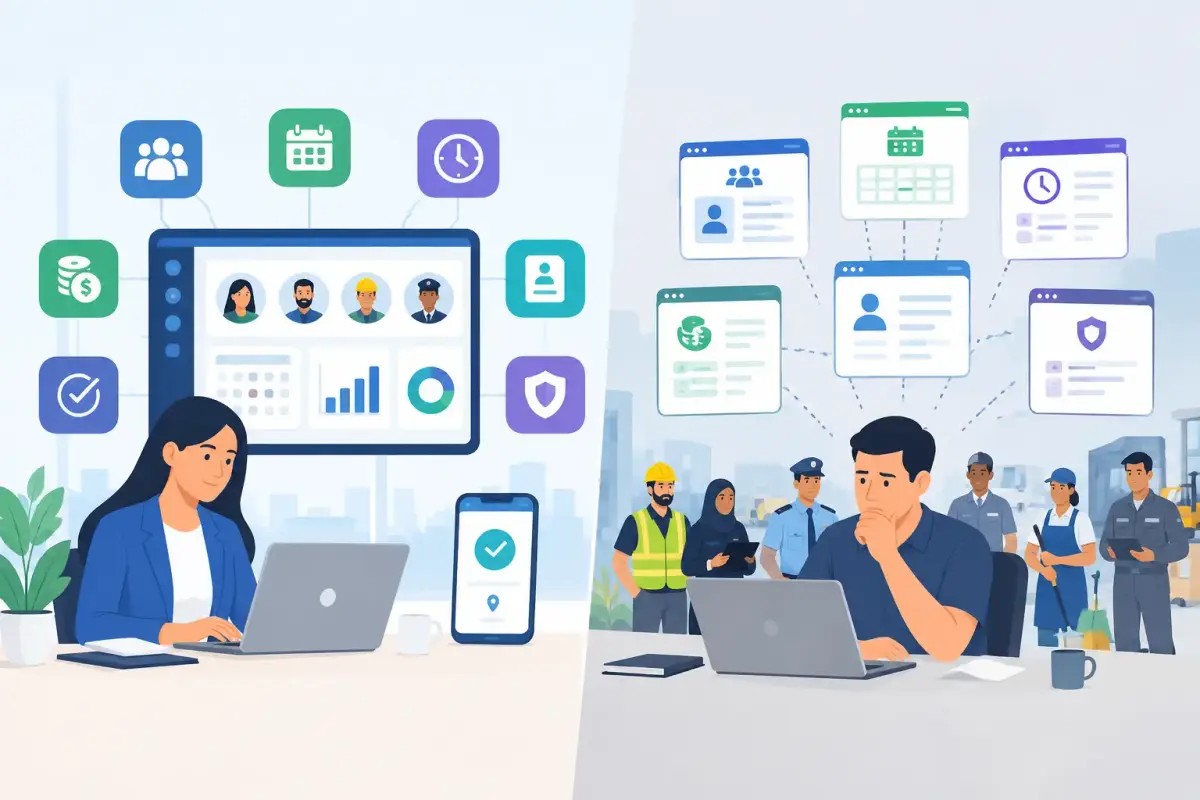
A payroll discrepancy is raised on payday. HR checks the employee record, finance checks a spreadsheet, and operations checks a separate attendance app. By the time the numbers are reconciled, managers have spent hours finding data that should have been connected from the start. That is the real decision behind HRMS versus separate tools: not simply software preference, but how much time, accuracy, and visibility your business is prepared to lose to disconnected processes.
For a small team with basic needs, individual tools can appear faster and less expensive. As employee numbers, locations, shifts, approvals, and payroll variables grow, that choice often creates manual work that is hard to see until it becomes a monthly problem.
Why separate HR tools seem practical at first
Many businesses begin with separate solutions for valid reasons. A spreadsheet handles employee data, a clocking app records attendance, email manages leave approvals, and payroll is prepared in another system. Each tool may do one job well, and the upfront cost can look lower than adopting a full HRMS.
This arrangement can work when the workforce is small, schedules are predictable, and only one person manages HR administration. It can also suit companies with a short-term requirement that does not need to connect with payroll, attendance, or employee records.
The challenge begins when the same employee information must be entered, checked, or approved in several places. A new salary adjustment may be updated in the employee file but missed in payroll. An approved leave request may not reach the attendance team. A late timesheet may affect overtime calculations after payroll preparation has already started.
These are not usually major system failures. They are handoff failures. And handoffs become more frequent as the business grows.
HRMS versus separate tools: the operational difference
An HRMS brings core workforce information and workflows into one connected environment. Employee records, documents, leave balances, attendance, shifts, timesheets, payroll inputs, claims, approvals, and reports are managed from the same source of data.
That changes the daily experience for HR, finance, managers, and employees. Instead of asking which spreadsheet is current or whether a manager has approved a request by email, teams can follow a defined workflow with a visible status.
The value is especially clear in payroll. Payroll is not an isolated monthly task. It relies on accurate employee data, attendance, absences, overtime, salary adjustments, deductions, expense claims, and approvals. When these details sit across separate tools, payroll teams must collect and validate them manually. An HRMS reduces those repeated checks by connecting payroll inputs to the processes that create them.
For UAE businesses, a localized platform can also support payroll processes aligned with UAE WPS requirements, while helping teams maintain clearer records and reduce avoidable data-entry errors. It should support compliance efforts, not replace professional legal or financial guidance.
Attendance is where disconnected systems become expensive
Attendance is often the first process to expose the limits of separate tools, particularly in construction, security, facility management, cleaning, maintenance, logistics, and staffing operations. Employees may work different sites, fixed or rotating shifts, split schedules, or variable overtime patterns.
A standalone clocking app may capture a punch, but operations still needs to know whether the employee was at the assigned location, whether the shift was approved, and how exceptions affect payroll. If that data must be exported and cleaned before each payroll cycle, the business has not automated attendance. It has only digitized one part of it.
A connected HRMS can bring mobile clock-in and clock-out, geofencing, face recognition, shift management, absence tracking, overtime records, and timesheet approvals into one workflow. Managers gain faster site-level visibility, while HR and finance receive more reliable inputs for payroll.
The hidden cost of using separate tools
The subscription fee is only one part of the cost. Separate tools create operational overhead that rarely appears on a purchase order: duplicate data entry, spreadsheet reconciliation, approval follow-ups, employee queries, training across multiple interfaces, and reporting work at month-end.
Consider a simple leave request. With disconnected systems, an employee submits a request in one place, a manager approves it by email or in another app, HR updates the balance, and payroll may need a separate notification if the leave affects pay. Each step depends on someone remembering to complete the next step.
With an HRMS, the request can follow a defined approval path, update the employee record, show the correct balance, and feed relevant payroll information into the same system. The process is simpler because the data does not need to travel through several disconnected channels.
Separate tools can also weaken reporting. One report may show headcount, another attendance, and another payroll figures, but they may reflect different update times or employee details. Leaders then spend meetings debating the numbers rather than acting on them.
When separate tools may still be the right choice
An HRMS is not automatically the best option for every company. If a business has very few employees, no complex attendance needs, straightforward monthly payroll, and stable processes, separate tools may be enough for now. The company should avoid paying for modules it will not use.
The key question is not whether separate tools are cheaper this month. It is whether they still make sense when the company adds employees, sites, shift types, approval layers, or payroll complexity.
Separate tools may also be reasonable when a specialized process is genuinely independent from HR operations. But if information affects employee records, working hours, leave, payroll, expenses, or manager approvals, separation usually creates more administration than value.
What to evaluate before choosing an HRMS
The strongest HRMS decision starts with your current workflow, not a feature checklist. Map what happens from onboarding through daily attendance, leave, approvals, payroll preparation, claims, and offboarding. Then identify where teams re-enter information, chase approvals, or depend on spreadsheets to make systems agree.
Look for a platform that fits the way your workforce actually operates. Office-based teams may prioritize employee self-service, leave workflows, document management, and payroll accuracy. Field and site-based businesses may need mobile attendance, location controls, face recognition, variable shifts, overtime tracking, and operations visibility.
Ease of use matters as much as functionality. A system only delivers value when employees clock in correctly, managers approve requests on time, and HR can complete payroll without a lengthy technical process. Arabic and English support can also make adoption easier for diverse workforces across the GCC and MENA region.
Finally, assess implementation in practical terms. Can employee data be organized cleanly? Can approval workflows reflect your structure? Can managers access only what they need? Can payroll, leave, and attendance work together without constant exports? These questions reveal whether the platform will reduce work or simply become another tool to manage.
A connected system creates better daily decisions
The case for an HRMS is not that every process must be complicated or heavily customized. The best systems remove unnecessary steps. Employees can access their information and submit requests themselves. Managers can approve from a clear queue. HR can maintain one employee record. Finance can work with payroll inputs that are traceable back to approved attendance and workforce data.
Mowazaf is built around this practical approach, combining HR, attendance, leave, payroll, workflows, and workforce management in one localized platform for growing UAE and GCC businesses. The goal is not more software for its own sake. It is fewer manual handoffs and clearer control over everyday workforce operations.
If your team spends payroll week comparing files, asking managers for missing attendance, or correcting leave balances after the fact, the issue is likely not effort. It is system design. A connected HRMS gives growing teams a simpler foundation to work faster, make decisions with confidence, and spend more time managing the workforce rather than managing the tools.