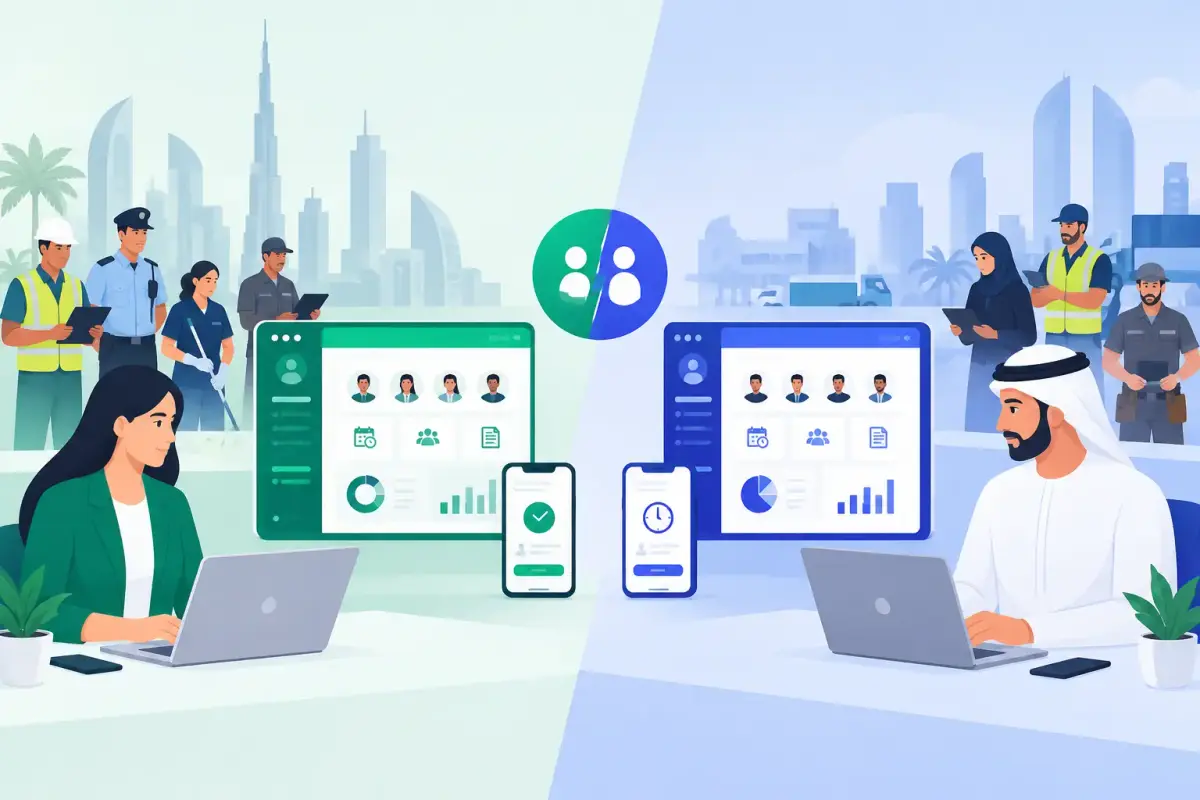
A payroll run that takes days, disputed clock-ins from site teams, and leave requests buried in messages are not separate problems. They are signs that HR, finance, and operations are working from disconnected processes. When comparing Mowazaf vs Bayzat, the right choice depends less on a feature checklist and more on how well the system handles your company’s actual day-to-day workforce requirements.
For a growing UAE or GCC business, the decision usually comes down to simplicity, payroll accuracy, attendance control, employee self-service, and the ability to keep operations moving without adding administrative work.
Mowazaf vs Bayzat: Start With Your Operating Reality
Both platforms are designed to help businesses move beyond spreadsheets and manual HR administration. A useful comparison should therefore focus on the workflows that create the most pressure: managing employee data, processing payroll, approving time and leave, and giving managers reliable visibility.
The better platform is not automatically the one with the longest feature list. It is the one your HR team, managers, finance team, and employees will use consistently. That matters even more when your workforce is spread across offices, sites, shifts, or multiple locations.
Mowazaf is built around practical HRMS, payroll, attendance, and workforce management needs for small and mid-sized companies and operational workforces. Its approach is centered on making core processes easy to run from one system, with regional requirements in mind.
Bayzat may be worth evaluating for organizations whose priorities align with its available HR and payroll offerings. However, any buyer should confirm the exact modules, regional coverage, workflow options, payroll capabilities, implementation scope, and commercial terms that apply to their business before making a decision.
The Comparison Areas That Matter Most
HR administration and employee records
A central employee record should reduce repetitive work, not become another database that HR has to maintain. Look for a system that organizes employee information, documents, onboarding tasks, leave balances, approvals, and employee requests in one clear place.
For lean HR teams, ease of use matters as much as capability. If employees cannot find their own documents, submit requests, or update relevant information through self-service, those routine questions return to HR by email and chat. Managers also need a simple view of their teams without broad access to information they do not need.
Ask each provider to show the actual employee and manager experience, not only the administrator dashboard. A clean workflow for requesting leave, checking balances, approving claims, or accessing documents can save significant time across the business.
Payroll workflows and accuracy
Payroll is where fragmented data becomes expensive. Attendance exceptions, overtime, unpaid leave, allowances, deductions, adjustments, and expense claims all affect the final payroll calculation. If these inputs are collected manually from separate files, finance must spend more time checking data and resolving errors.
A suitable platform should bring HR and payroll data closer together, with clear approval steps before payroll is finalized. For UAE-based organizations, it is also sensible to assess whether the solution supports UAE WPS payroll requirements and the reporting format your finance process needs.
Do not treat payroll as a standalone feature. During a demo, ask how approved leave, overtime, attendance records, salary changes, and claims flow into payroll. Then ask what happens when an adjustment is needed after a payroll draft is prepared. The answer reveals far more than a simple payroll checkbox.
Attendance, shifts, and field workforce control
This is often the deciding category for construction, security, cleaning, maintenance, facility management, logistics, and staffing businesses. An office-only attendance process may work for a small desk-based team. It can break down quickly when employees report to changing sites, work variable shifts, or need supervisors to verify hours before payroll.
Mowazaf is particularly suited to businesses that need mobile and desktop clock-in and clock-out, geofencing, face recognition, fixed and variable shifts, timesheets, overtime tracking, and absence visibility. These tools help operations teams replace paper registers, delayed timesheets, and avoidable attendance disputes with clearer records and approvals.
When comparing platforms, test the field scenario that causes the most friction in your company. For example, can a supervisor review site attendance quickly? Can an employee be assigned to a changing shift? Can approved timesheets feed into payroll without rekeying data? Can managers see exceptions before they become month-end problems?
If your workforce is primarily office-based, advanced attendance controls may not be your top priority. If workers are distributed across sites or shifts, they should be central to the decision.
Leave, claims, and approval flows
Leave management looks simple until approval rules vary by department, manager, location, or leave type. The same is true for expense claims and payroll adjustments. Without defined workflows, approvals sit in inboxes, payroll deadlines tighten, and employees lack visibility into the status of their requests.
Evaluate whether each system can reflect the way your business actually works. Flexible workflow automation is valuable when approvals need to move between managers, HR, finance, or operations without constant follow-up. The goal is not to add layers of process. It is to make the required process visible, timely, and consistent.
A strong employee self-service experience also reduces unnecessary HR tickets. Employees should be able to submit requests, track approval status, view relevant balances, and access their information without waiting for someone to send a spreadsheet or search through emails.
Regional fit and language support
Global HR software can appear polished but still create operational gaps when local payroll, language, or workforce practices are treated as an afterthought. For organizations operating in the UAE and wider MENA region, regional fit should be assessed early.
Mowazaf supports Arabic and English environments and is localized for businesses in the UAE, Saudi Arabia, Egypt, Lebanon, and Syria. That focus can be especially useful for companies managing multilingual teams and region-specific HR and payroll workflows.
Localization does not remove the need for internal review. Every company has its own salary structures, attendance rules, approval hierarchy, and payroll controls. But choosing a platform designed with GCC and MENA operations in mind can reduce the amount of workaround-heavy configuration your team must maintain.
Which Platform May Fit Your Business?
Bayzat may be a reasonable option for a business that has reviewed its available modules and found that its HR and payroll approach matches the company’s needs. The key is to validate the workflows your team will run every week and every month, rather than deciding based on a high-level product tour.
Mowazaf may be the stronger fit when your priority is a simple, centralized platform for HR, payroll, leave, approvals, attendance, shifts, timesheets, and workforce operations. It is especially relevant for growing companies that want to reduce spreadsheet dependency and for heavy-workforce businesses that need reliable site-level time and attendance visibility.
The practical difference is often adoption. A powerful system that managers avoid, field employees struggle to use, or finance cannot trust will not deliver the intended return. A system that fits daily work patterns can reduce approval delays, improve payroll inputs, and give leaders clearer operational data.
Questions to Ask During a Demo
Use a real scenario, not a generic walkthrough. Ask each provider to show how an employee clocks in from a work site, how a manager approves a timesheet and overtime, how leave affects payroll, and how finance reviews payroll changes before finalization.
Also ask who can configure workflows, how employee records and documents are managed, what reporting is available, and how mobile self-service works for employees who do not sit at a desk. If your company operates in more than one country or language, include that scenario in the discussion.
Finally, consider implementation effort. A system does not need to be overly complex to support serious workforce operations. The best fit should give your team enough control without requiring extensive training or ongoing dependence on manual workarounds.
A focused demo with your real payroll and attendance challenges on the screen will make the choice clearer. Choose the platform that helps your people spend less time chasing data and more time running the business with confidence.