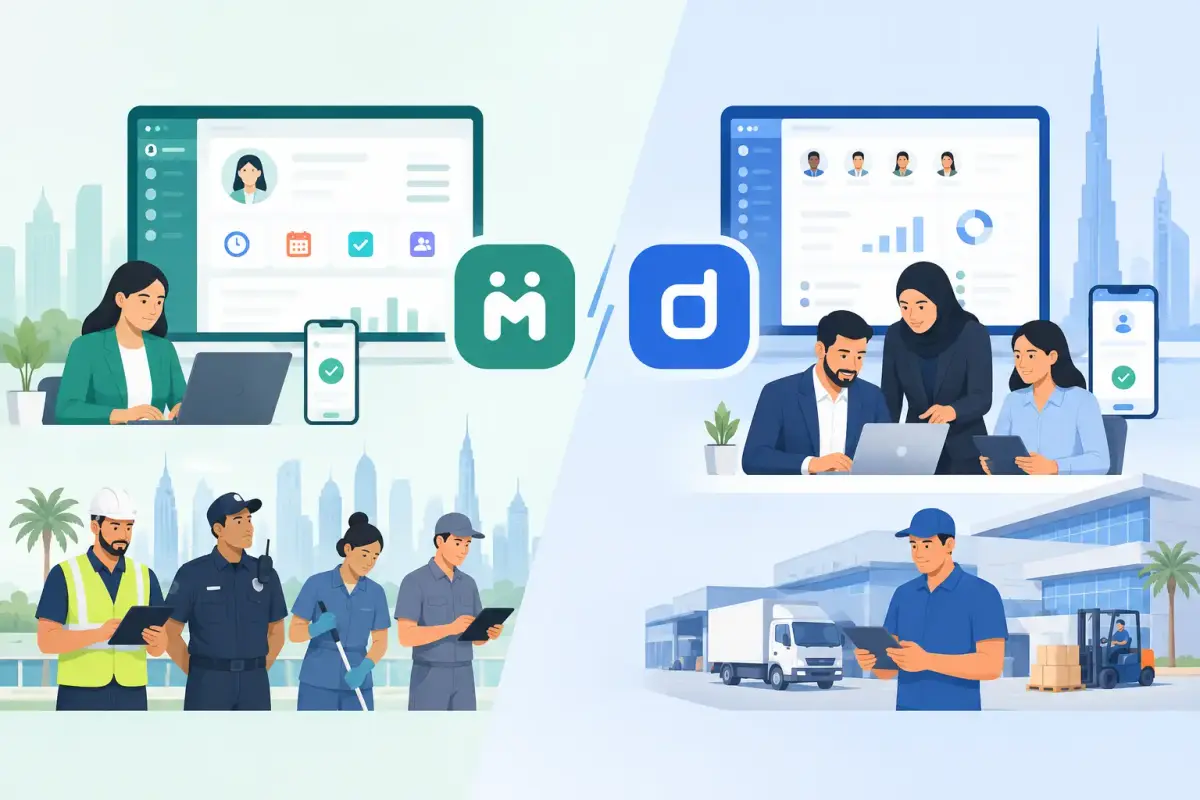
A payroll run should not depend on chasing handwritten timesheets, correcting shift records, and following up on approvals at the end of every month. That is the practical context for a Mowazaf vs Darwinbox comparison: the right choice depends less on a long feature list and more on how well the system fits your workforce, local processes, and daily operating pressure.
Both platforms aim to centralize people operations. But companies in the UAE and GCC should look beyond core HR records. Attendance rules, field teams, Arabic and English usability, payroll preparation, approval speed, and the amount of training required can have a direct effect on accuracy and productivity.
Mowazaf vs Darwinbox: The Core Difference
Darwinbox is commonly evaluated by organizations looking for a broad human capital management platform with extensive enterprise capabilities. It can be a sensible option for larger organizations that have dedicated HR technology teams, formal implementation capacity, and complex requirements across multiple business units.
Mowazaf takes a more operationally focused approach for small and mid-sized businesses, growing companies, and workforce-heavy operations. The priority is to make essential HR, payroll, attendance, leave, approvals, and workforce processes easier to run every day without turning HR software into a major internal project.
This difference matters because software adoption is not measured by what a platform can demonstrate. It is measured by whether supervisors approve timesheets on time, whether employees can clock in correctly at a worksite, and whether finance receives accurate payroll inputs without rebuilding them in spreadsheets.
For a fast-growing business, a system that employees and managers can use with minimal training may deliver more value than a broader platform that requires significant configuration before teams feel comfortable using it.
Compare the Workflows That Affect Your Business
A useful evaluation starts with real scenarios, not generic feature checklists. Ask each provider to demonstrate the same processes your team handles each week and month.
HR administration and employee self-service
Both platforms can support core employee information and digital HR processes. The key question is how quickly an HR team can organize employee files, request documents, manage onboarding and offboarding tasks, and route routine approvals.
For growing companies, simplicity has a financial impact. When employees can update the information they are allowed to manage, submit requests, and view relevant records through self-service, HR has fewer repetitive follow-ups. Managers also gain clearer visibility without becoming dependent on HR for every basic request.
Mowazaf is designed around this practical use case, bringing employee records, documents, leave, claims, approvals, and employee and manager self-service into one cloud-based system. Public shareable employee profiles can also serve as digital business cards where that is useful for the business.
Attendance, shifts, and field workforce visibility
This is often the deciding area for construction, security, cleaning, maintenance, logistics, and facility management businesses. A standard attendance tool may work well for a single office but struggle when employees work at multiple sites, follow variable shifts, or submit timesheets that require supervisor approval.
When comparing Mowazaf vs Darwinbox, test attendance using your actual workforce model. Can employees clock in and out from mobile or desktop? Can the business apply geofencing and face recognition where appropriate? Can supervisors see attendance by site, review overtime, manage fixed and variable shifts, and approve timesheets without a separate process?
Mowazaf is particularly suited to these operational needs. It supports mobile attendance, geofencing, face recognition, shift management, absence and overtime tracking, timesheets, and site-level workforce visibility. This reduces the gap between HR records and what is happening across sites each day.
That does not mean every company needs field-force functionality. An office-based professional services company with consistent schedules may place greater weight on leave workflows and payroll approval controls. The right platform is the one that solves the operational complexity you actually have.
Payroll accuracy and regional readiness
Payroll is where disconnected data becomes expensive. If attendance, overtime, salary changes, leave deductions, claims, and approvals are held in separate tools, the payroll team spends time reconciling inputs before it can process anything.
A strong HRMS should help centralize these inputs and give finance a clear approval trail. In the UAE, companies should also ask how the platform supports UAE WPS payroll requirements and what payroll processes are available for their operating locations. Software can support compliance and help reduce errors, but each company remains responsible for validating its payroll setup and internal policies.
Mowazaf connects payroll preparation with attendance, leave, salary adjustments, claims, and expense workflows. Its regional focus includes the UAE, Saudi Arabia, Egypt, Lebanon, and Syria, with Arabic and English support. For a GCC business, that localization can be more immediately useful than a globally broad platform if the goal is to reduce manual payroll work now.
Darwinbox may be worth deeper review if your organization needs a larger HCM footprint across many countries or has a formal global HR technology strategy. Confirm country-specific payroll availability, implementation scope, and any local requirements directly during the evaluation rather than assuming all modules operate the same way in every market.
Automation without operational friction
Workflow automation should remove delays, not create a complicated approval map that no one understands. Consider routine requests such as leave, overtime, claims, shift changes, timesheet corrections, and employee document approvals. Then ask how easily the approval path can reflect your reporting structure.
Mowazaf emphasizes flexible workflows that fit real HR, finance, and operations processes. The platform also includes an AI layer for employee engagement and performance insights. The practical benefit is not automation for its own sake. It is faster routing, better visibility, and fewer requests lost in email or paper forms.
Which Platform Fits Your Company?
Choose based on operating model, not company ambition alone. A larger platform can be appropriate when your organization has complex enterprise governance, a dedicated implementation team, and the time to configure a broad HR environment. In that case, Darwinbox may deserve consideration alongside other enterprise-oriented options.
A growing UAE or GCC company may get a stronger day-to-day fit from Mowazaf when it needs HR, attendance, leave, timesheets, payroll inputs, and employee self-service to work together simply. This is especially relevant when payroll teams still depend on manual files, managers are slow to approve requests, or field attendance disputes consume too much time.
The same applies to heavy-workforce businesses. If a supervisor needs to verify who arrived at a specific location, review shift exceptions, and approve overtime before payroll, specialized workforce controls are not an extra. They are part of the core HR process.
Questions to Ask Before You Decide
Do not settle for a presentation built around ideal workflows. Give each vendor a practical test. Ask them to show how a new employee is added, how documents are collected, how a leave request moves through approval, how a field employee clocks in, how a variable shift affects attendance, and how approved changes reach payroll.
Also clarify implementation ownership, training needs, available Arabic and English experiences, reporting access for managers, data migration expectations, support response processes, and costs that may arise as employees or modules are added. A lower initial price does not help if the system creates manual work. A larger platform does not help if employees avoid using it.
The best decision is the one that gives HR, finance, and operations a shared source of truth while making work easier for the people expected to use it.