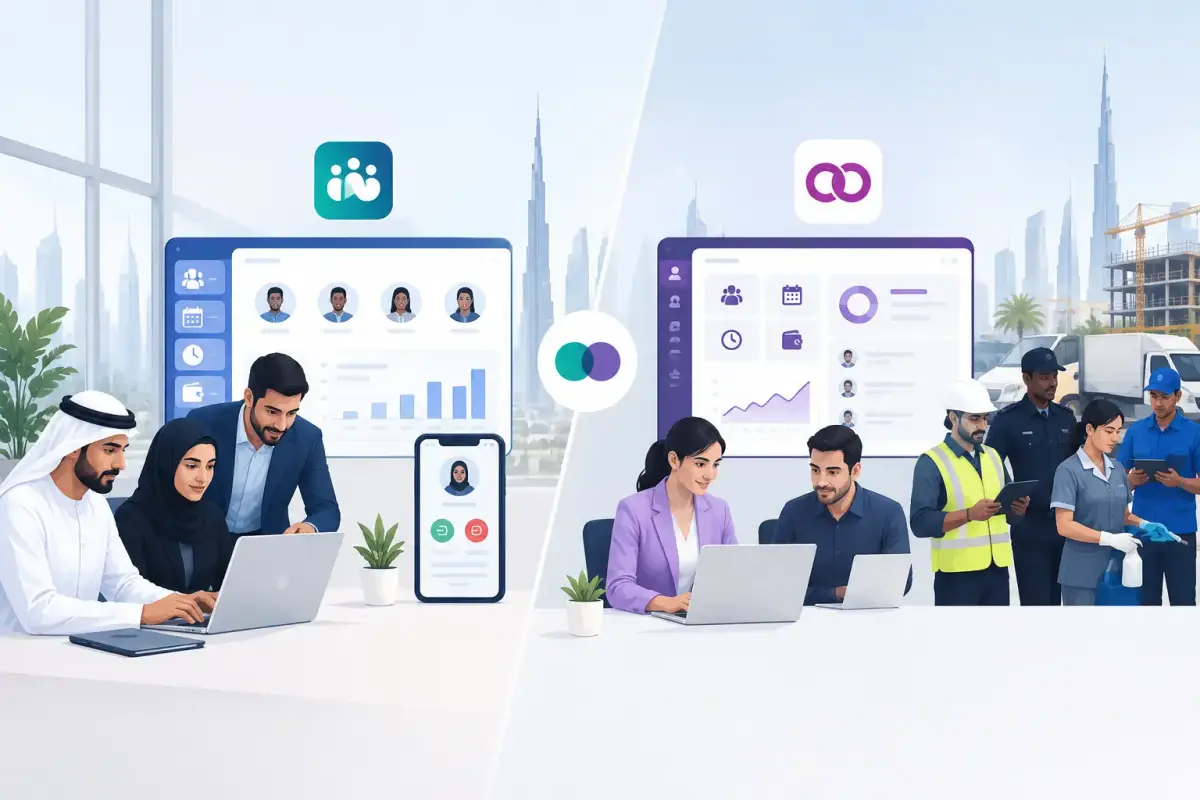
A payroll cutoff is approaching, site supervisors are chasing missing clock-ins, and HR is still following up on leave approvals. This is where the Mowazaf vs Odoo decision becomes practical, not theoretical. The right system is the one that helps your team complete daily HR and workforce tasks with less manual work, clearer approvals, and fewer payroll surprises.
For growing businesses, software choice is rarely about having the longest feature list. It is about whether HR, finance, managers, and employees can use the system consistently. Companies in the UAE and GCC also need to consider regional payroll processes, bilingual teams, mobile attendance, and workforce operations that do not always happen behind a desk.
Mowazaf vs Odoo: The Core Difference
Mowazaf is built as a focused HRMS and workforce management platform for companies that need to organize employees, attendance, leave, payroll, shifts, timesheets, approvals, and workforce operations in one practical system. Its approach is centered on making daily HR work easier for SMEs, growing companies, and businesses with site-based or shift-based teams.
Odoo is a broad modular business software platform with HR applications among its available modules. This can appeal to organizations that want a highly configurable environment and have the internal resources or external support to set up, connect, and maintain the workflows they need.
Neither approach is automatically better. The real question is whether your company needs a specialized, ready-to-use HR and workforce platform or a broader modular platform that may require more configuration to match your processes.
Compare the Work That Actually Creates Delays
A useful comparison starts with the moments that create pressure for HR and operations teams: onboarding a new employee, approving a timesheet, resolving a disputed attendance record, calculating overtime, processing salary adjustments, or preparing payroll before the deadline.
Attendance and field workforce visibility
Attendance is often where disconnected tools create the most friction. Office teams may need a simple clock-in process and manager visibility. Construction, security, cleaning, maintenance, logistics, and staffing businesses may need much more: mobile clock-in and clock-out, geofencing, face recognition, fixed and variable shifts, site-level visibility, overtime tracking, and timesheet approvals.
A focused workforce platform can make these workflows easier to manage because attendance, shifts, absence records, and payroll inputs are designed to work together. Mowazaf supports mobile and desktop attendance, geofencing, face recognition, flexible shifts, and operational workflows for companies managing employees across sites.
With Odoo, the result depends heavily on the modules selected and the way workflows are configured. That flexibility may be valuable for companies with unusual internal processes. However, teams should confirm that the attendance rules, approval flows, mobile experience, and payroll inputs reflect the reality of their workforce before committing.
Payroll accuracy and regional fit
Payroll is not simply a monthly calculation. It relies on dependable employee data, approved attendance, leave records, overtime, deductions, claims, and salary adjustments. When these inputs live in spreadsheets or disconnected systems, payroll teams spend their time checking data rather than reviewing exceptions.
For UAE businesses, it is sensible to assess whether the platform supports UAE WPS payroll requirements and provides payroll workflows that fit local operations. Mowazaf is designed with UAE and regional HR and payroll needs in mind, helping teams centralize the inputs that affect payroll and reduce avoidable manual errors.
Odoo can be configured for many business scenarios, but regional payroll readiness should be evaluated carefully. Ask who will maintain payroll rules, how changes are handled, whether reports meet your internal requirements, and how attendance and leave data move into the payroll process. A flexible system is only useful when the responsibility for keeping it accurate is clear.
Employee and manager self-service
The best HR process is often the one that HR does not need to chase. Employees should be able to request leave, submit claims, access relevant documents, view their records, and complete simple actions without sending repeated emails. Managers need clear approvals and visibility without becoming bottlenecks.
Both types of platforms can support self-service, but ease of adoption matters. A system that requires extensive training, complicated navigation, or frequent administrator support can recreate the same delays it was meant to remove. For growing organizations, simple employee and manager self-service can have a direct impact on HR workload and response times.
Configuration, Simplicity, and Ownership
The Mowazaf vs Odoo comparison often comes down to a trade-off between focused simplicity and broad configurability.
Odoo may suit a business that already has technical resources, clear process ownership, and a strong reason to build customized workflows around a modular platform. It can offer room to shape processes in detail. That also means the company should plan for setup decisions, testing, ongoing changes, and support when processes evolve.
Mowazaf is a stronger fit when the priority is to get HR, attendance, leave, payroll, and workforce workflows running without adding unnecessary complexity. Its value is not just in centralizing records. It is in helping everyday users complete the work: employees clock in, managers approve requests, HR tracks exceptions, and finance receives more reliable payroll inputs.
This difference matters most for companies that are replacing paper forms, spreadsheets, WhatsApp attendance updates, or separate tools that do not communicate well. In those environments, a system that people can understand quickly is often more valuable than one with unlimited configuration options that go unused.
Which Platform Fits Your Company?
Choose based on operating reality, not software labels. Odoo may be appropriate if your organization needs a highly tailored setup, has the capacity to manage technical configuration, and is comfortable defining and maintaining its own workflow structure.
Mowazaf may be the better choice if your company wants a localized HR and workforce system that is ready for practical UAE and GCC operations. It is especially relevant when attendance control, shifts, payroll inputs, overtime, mobile teams, and approval speed are daily priorities rather than occasional tasks.
For a 30-person office, the deciding factor may be simple leave approvals, employee records, and payroll preparation. For a 300-person field workforce, it may be geofenced attendance, site-level shifts, timesheets, absence visibility, and the ability to resolve attendance issues before they become payroll disputes. The platform should match those operational demands without forcing HR to become a software administration team.
Questions to Ask Before You Decide
Ask each vendor to show your real workflow, not a generic product tour. Start with an employee joining the company, taking leave, clocking in at a worksite, submitting a claim, working overtime, and appearing in payroll. Then ask what happens when a manager misses an approval or an attendance record needs correction.
Also clarify implementation ownership, training needs, mobile access, Arabic and English usability, approval controls, reporting, and the effort required to change a workflow later. These details reveal whether a system will save time after launch or simply move manual work into a new interface.
A good HR platform should make the next payroll cycle calmer, the next approval faster, and the next attendance question easier to answer.