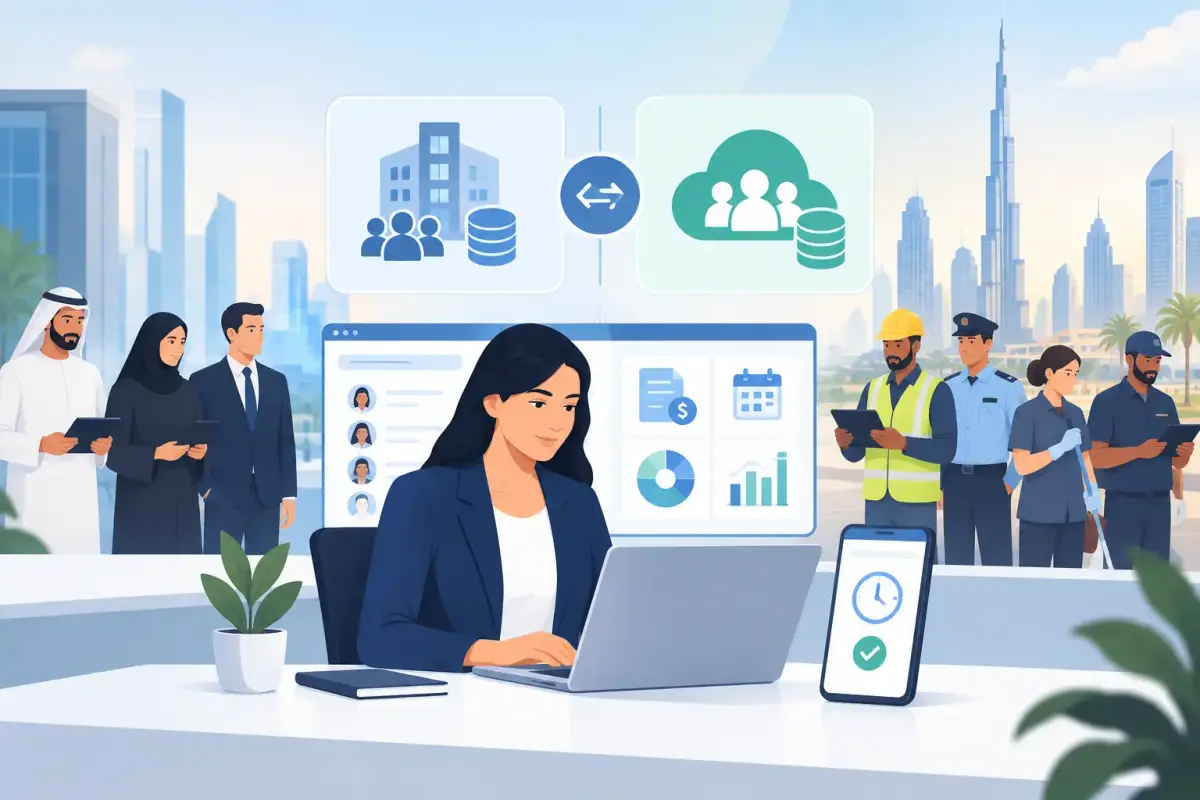
A payroll outsourcing comparison is rarely just about the monthly provider fee. For a growing business, the real decision is whether outsourcing removes work or simply moves it outside the company while HR and finance still chase attendance data, approve adjustments, and answer employee questions.
For UAE and GCC businesses, the right model depends on workforce complexity. A 30-person office with fixed salaries has different needs from a security, cleaning, construction, or logistics company managing shifts, overtime, site attendance, and frequent payroll changes. The best choice is the one that gives your team reliable payroll results without creating a new layer of manual coordination.
What payroll outsourcing actually means
Payroll outsourcing means engaging an external provider to perform some or all payroll tasks. Depending on the arrangement, the provider may calculate salaries, prepare payment files, produce payslips, maintain payroll records, and support required reporting.
However, outsourcing does not remove the need for accurate internal inputs. Someone still has to confirm employee master data, approved leave, unpaid absences, overtime, deductions, allowances, claims, salary adjustments, and final settlements. If these inputs arrive through spreadsheets, paper forms, WhatsApp messages, or disconnected attendance devices, the provider receives incomplete or late data. The payroll may be outsourced, but the pressure remains in-house.
That distinction matters when evaluating providers. Ask not only, "Who runs the calculation?" Ask, "How will approved workforce data reach the calculation without rework?"
Payroll outsourcing comparison: three operating models
Most businesses choose between full-service outsourcing, in-house payroll software, or a hybrid approach. There is no universal winner. The right option depends on headcount, payroll variability, internal capability, and how closely payroll connects to daily workforce operations.
1. Full-service payroll outsourcing
With full-service outsourcing, a specialist handles most payroll processing after receiving your data. This can suit smaller companies with relatively stable pay structures and limited internal HR administration.
The clearest benefit is reduced processing effort. Your team does not need to maintain complex calculation logic or spend as much time preparing each payroll run. A capable provider can also bring useful process discipline, particularly when the business is moving away from ad hoc spreadsheets.
The trade-off is control and turnaround time. Every salary adjustment, missing attendance record, leave correction, or employee query may become a request to the provider. If workforce data changes often, the company can end up spending substantial time compiling templates, reviewing files, and resolving exceptions before the provider can finalize payroll.
Full outsourcing is usually most effective when payroll inputs are simple, standardized, and submitted on a predictable schedule.
2. In-house payroll with a localized HRMS
In-house payroll does not mean returning to manual spreadsheets. With a localized HRMS and payroll platform, HR and finance teams manage payroll internally using a system that brings employee records, attendance, leave, approvals, claims, and payroll together.
This model gives businesses greater visibility. Approved attendance and leave data can flow into payroll preparation, managers can approve changes within defined workflows, and employees can access self-service information instead of sending repeated requests to HR. The payroll team retains direct control over cutoffs, validations, adjustments, and final review.
For UAE companies, a platform that supports UAE WPS payroll requirements can reduce the operational burden of preparing payroll files. It can also help teams keep payroll data organized and traceable. That said, the business remains responsible for its own payroll process, approvals, and data quality. Software makes the work simpler and more consistent, but it does not replace accountable internal review.
This option often works well for growing companies and operational workforces because payroll stays connected to what happens every day: clock-ins, shifts, overtime, absences, and expense claims.
3. The hybrid model
A hybrid model combines internal workforce management with external payroll support. The company uses an HRMS to maintain clean employee and attendance data, while a provider assists with processing, specialized review, or selected payroll tasks.
This approach can be practical for businesses that want stronger internal control without building a large payroll team. It also reduces the back-and-forth that often weakens outsourcing arrangements. Instead of manually rebuilding reports each month, HR can provide structured, approved data from one system.
The main requirement is clear ownership. Decide who owns employee data, who validates attendance, who approves payroll changes, who handles employee questions, and who signs off before payment. A hybrid arrangement fails when each side assumes the other has checked the numbers.
Compare the costs beyond the provider quote
A low outsourcing fee can look attractive until the hidden operating cost becomes visible. Build your comparison around the total effort required to produce an accurate payroll, not just the invoice from the provider.
Consider the time HR spends collecting attendance, the time operations managers spend confirming overtime, the cost of correcting late or inaccurate data, and the effort needed to answer payslip questions. Also consider whether every off-cycle payment, employee change, or additional report carries a separate charge.
For heavy-workforce companies, these costs can rise quickly. A small payroll team may spend days reconciling shift records from several sites before it can even send a file to an outsourcing partner. In that situation, improving attendance capture and approvals may create more value than changing providers.
Ask providers and software vendors how they handle payroll revisions, multiple pay groups, variable earnings, claims, deductions, final settlements, and reporting. The answers will reveal whether the solution fits your real process or only your standard monthly run.
Data accuracy starts before payroll day
Payroll errors usually begin at the source. A missed clock-out, an unapproved overtime request, or a leave record held in email can turn into a salary correction later. Outsourcing does not fix poor source data. It can only process what it receives.
A stronger setup connects payroll to the records that create pay changes. Mobile clock-in and clock-out, geofencing, face recognition, shift management, timesheets, leave workflows, and manager approvals help businesses create a clearer audit trail before payroll is prepared.
This is particularly valuable for employees working across customer sites, projects, branches, or changing schedules. Rather than asking payroll staff to interpret scattered files, the business can establish clear cutoff dates and use approved records as the basis for payroll.
Mowazaf supports this operational approach by bringing attendance, leave, timesheets, claims, employee records, and payroll workflows into one simple platform, with Arabic and English support for regional teams.
Questions to ask in a payroll outsourcing comparison
Before making a decision, focus on the working process rather than the sales presentation. A practical conversation should clarify these areas:
- How will approved attendance, leave, overtime, claims, and salary changes enter the payroll process?
- What is the cutoff schedule, and how are late changes handled?
- Who reviews payroll before payment, and what checks are available?
- Can managers approve workforce changes without paper forms and email follow-ups?
- How quickly can the team produce payslips, payroll reports, and employee-level explanations?
- Does the solution support the organization’s WPS payroll workflow and regional operating needs?
These questions are useful because they expose the handoffs. Most payroll delays happen between systems and people, not inside the final calculation.
When outsourcing is the better choice
Outsourcing can be a sensible option when your workforce is stable, your internal payroll knowledge is limited, and the provider can work from clean, consistent data. It can also help a business that needs processing support while it establishes better internal HR and attendance practices.
But if your organization manages rotating shifts, site-based employees, variable overtime, frequent changes, or multiple approval layers, outsourcing alone may not be enough. You may still need a centralized HRMS to control the data that drives payroll.
The practical goal is not to choose between people and technology. It is to create a payroll process where the right data is captured once, approved by the right person, and available when payroll needs it. Start by mapping your current handoffs. The points where teams re-enter data, chase approvals, or dispute attendance are the places where a better payroll model will make the biggest difference.