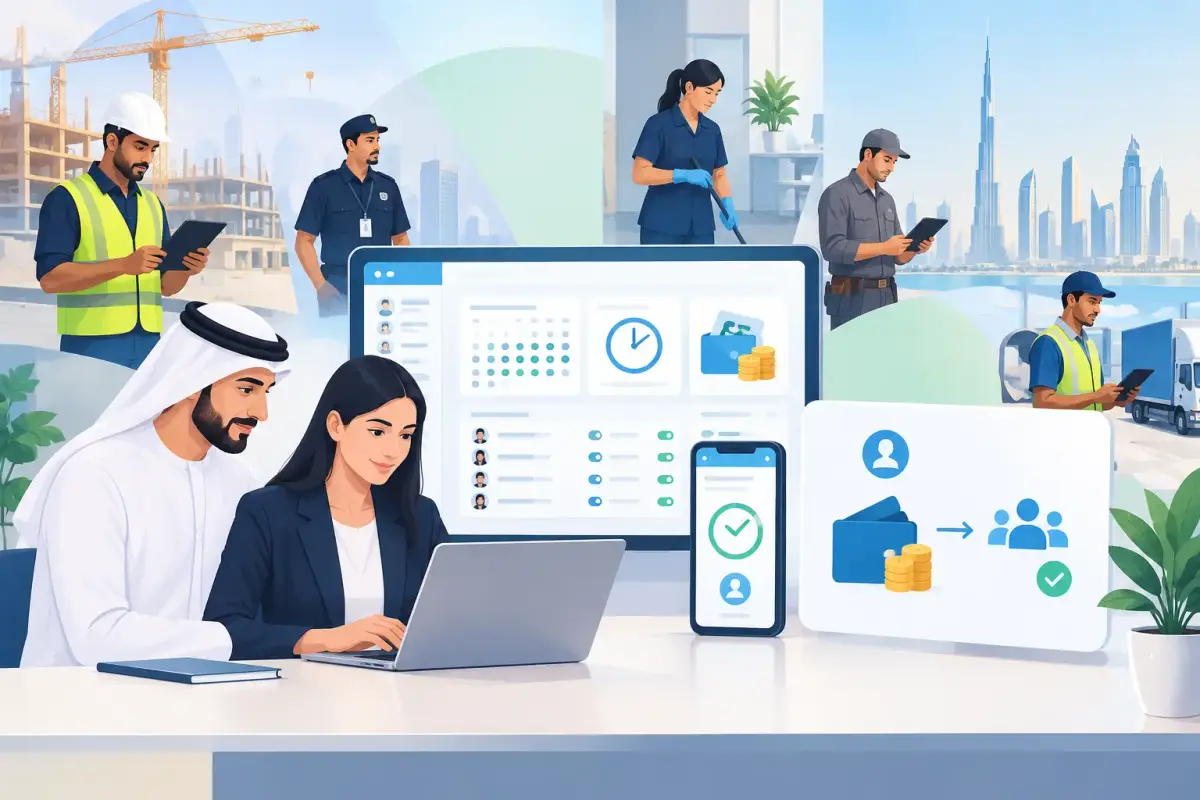
A missed clock-in at a project site, an unsigned leave request, and a late payroll adjustment can each seem small. When they are managed through spreadsheets, messages, and paper forms, they become a monthly cycle of chasing information. A UAE HRMS gives HR, finance, and operations teams one reliable place to manage the employee data and daily workforce activity that payroll depends on.
For growing businesses, the value is not simply having another system. It is replacing disconnected processes with clear workflows that employees and managers can actually use. The right platform should make routine work faster while giving decision-makers better visibility into attendance, leave balances, approvals, payroll inputs, and workforce costs.
What a UAE HRMS Should Solve
An HRMS is most useful when it reflects how your company operates. Office-based teams may need simple leave approvals, employee self-service, and organized records. A construction, security, cleaning, maintenance, logistics, or healthcare staffing business may also need site-based attendance, changing shifts, overtime tracking, and timesheet approvals.
Trying to run these processes in separate tools creates avoidable gaps. HR may hold employee documents in one folder, supervisors may track attendance in another file, and finance may receive payroll changes through email. Each handoff adds time and increases the chance that a missing update reaches payroll too late.
A practical UAE HRMS centralizes the core employee lifecycle after hiring: employee profiles, documents, onboarding and offboarding tasks, leave, attendance, shifts, timesheets, claims, approvals, and payroll data. That central record matters because the same employee information is used by multiple teams. HR needs it for administration, managers need it to run teams, and finance needs accurate inputs for payroll.
The goal is not to remove human review. Payroll and workforce decisions still need ownership. The goal is to make the information behind those decisions current, traceable, and easier to verify.
Payroll Accuracy Starts Before Payroll Day
Payroll problems rarely begin when the payroll file is prepared. They usually start earlier, when attendance is incomplete, overtime is not approved, salary changes are not recorded, or leave data is updated in more than one place.
An effective system connects these inputs through defined workflows. When a manager approves a timesheet, leave request, claim, or adjustment, the right people can see the status without sending follow-up emails. HR and finance can review exceptions before payroll is finalized instead of discovering them after employees have been paid.
For UAE companies, payroll software should also support UAE WPS payroll requirements and help teams organize payroll information in the required format. This does not replace internal controls or professional review, but it can reduce manual preparation and make recurring payroll work more consistent.
The best setup depends on the business. A company with fixed monthly salaries may prioritize employee records, leave, and approval controls. A business with shift workers, variable hours, multiple locations, or frequent overtime needs closer links between clock-in data, schedules, timesheets, and payroll calculations. One generic process will not fit both.
Attendance That Matches Real Operations
Attendance is often where simple HR tools fall short. A desktop-only clock-in method may work for employees in one office. It is less practical for teams working across client locations, construction sites, facilities, warehouses, or field assignments.
Mobile clock-in and clock-out give operational teams more flexibility, while geofencing can help confirm that attendance is recorded from an approved work location. Face recognition can add another layer of verification where appropriate. These capabilities should be applied thoughtfully, with clear company policies and an understanding of the workforce environment.
The point is not surveillance for its own sake. It is reducing attendance disputes, improving site-level visibility, and giving supervisors a clearer picture of who is present, late, absent, or working overtime. When the data is captured consistently, managers spend less time reconciling attendance and more time managing the work itself.
Shift flexibility is equally important. Some teams follow fixed schedules, while others rotate across day and night shifts or move between sites. A system should support fixed and variable shifts without forcing managers to rebuild schedules manually every time operations change.
Employee Self-Service Reduces Administrative Noise
HR teams should not have to answer the same questions repeatedly: How many leave days do I have? Has my claim been approved? Can I update my details? Where is my document? Employee self-service gives people a direct, controlled way to access the information and requests relevant to them.
When employees can submit leave requests, claims, and updates through a mobile or desktop portal, the request starts with complete information. Managers can approve or return it promptly, and HR has a record of the action. This creates a better employee experience without moving accountability away from HR.
Manager self-service is just as useful. A manager who can review team attendance, approve timesheets, and see pending requests from one place is less likely to hold up a workflow. For growing companies, those saved minutes add up quickly across departments.
Arabic and English support also matters in many UAE workplaces. It helps teams use the same system with less friction, particularly where employees, managers, and administrators work in different preferred languages.
How to Choose an HRMS Without Overbuying
A large feature list can be misleading. The right question is whether the platform solves the operational issues your company faces now and can continue to solve them as headcount, locations, and complexity grow.
Start by mapping your actual monthly process. Identify where employee data is stored, who approves leave and timesheets, how attendance is captured, how payroll changes reach finance, and where delays occur. This reveals whether the priority is payroll readiness, attendance control, approval speed, better records, or all of the above.
Then assess the system against four practical questions:
- Can employees, managers, HR, finance, and operations teams use it with minimal training?
- Does it support the attendance method, shifts, locations, and approval rules your workforce needs?
- Can payroll inputs be reviewed clearly before payroll processing begins?
- Does it provide useful reports without requiring a separate manual data cleanup process?
Simplicity should be a requirement, not a compromise. A system with every possible feature is not valuable if supervisors avoid it, employees cannot complete requests, or HR must maintain parallel spreadsheets to make it work.
It is also worth checking how configurable workflows are. Approval paths may differ by department, location, claim type, or employee level. A growing business needs enough flexibility to reflect these differences, but not so much complexity that every change requires technical intervention.
A Better Operating Rhythm for HR and Operations
The strongest HRMS implementations improve the rhythm of work. Employee data is updated once. Attendance is captured close to the source. Managers act on requests while they are still relevant. HR can see exceptions early. Finance receives cleaner, approved payroll inputs.
That rhythm is especially valuable in heavy-workforce businesses, where a single missed shift update can affect multiple employees, locations, and payroll records. Real-time visibility does not solve every operational issue, but it makes issues easier to spot before they become end-of-month corrections.
Mowazaf is built around this practical model: centralized HR, payroll, attendance, leave, approvals, and workforce operations in one cloud-based platform. Its mobile attendance, geofencing, face recognition, flexible shifts, timesheets, and UAE WPS payroll support are designed for companies that need operational control without enterprise-level complexity.
A good HRMS should make HR feel less like paperwork and more like a reliable operating system for the business. If your team is still reconciling attendance, leave, and payroll data by hand, start with the process causing the most friction and build from there.